

 Image 1 of 1
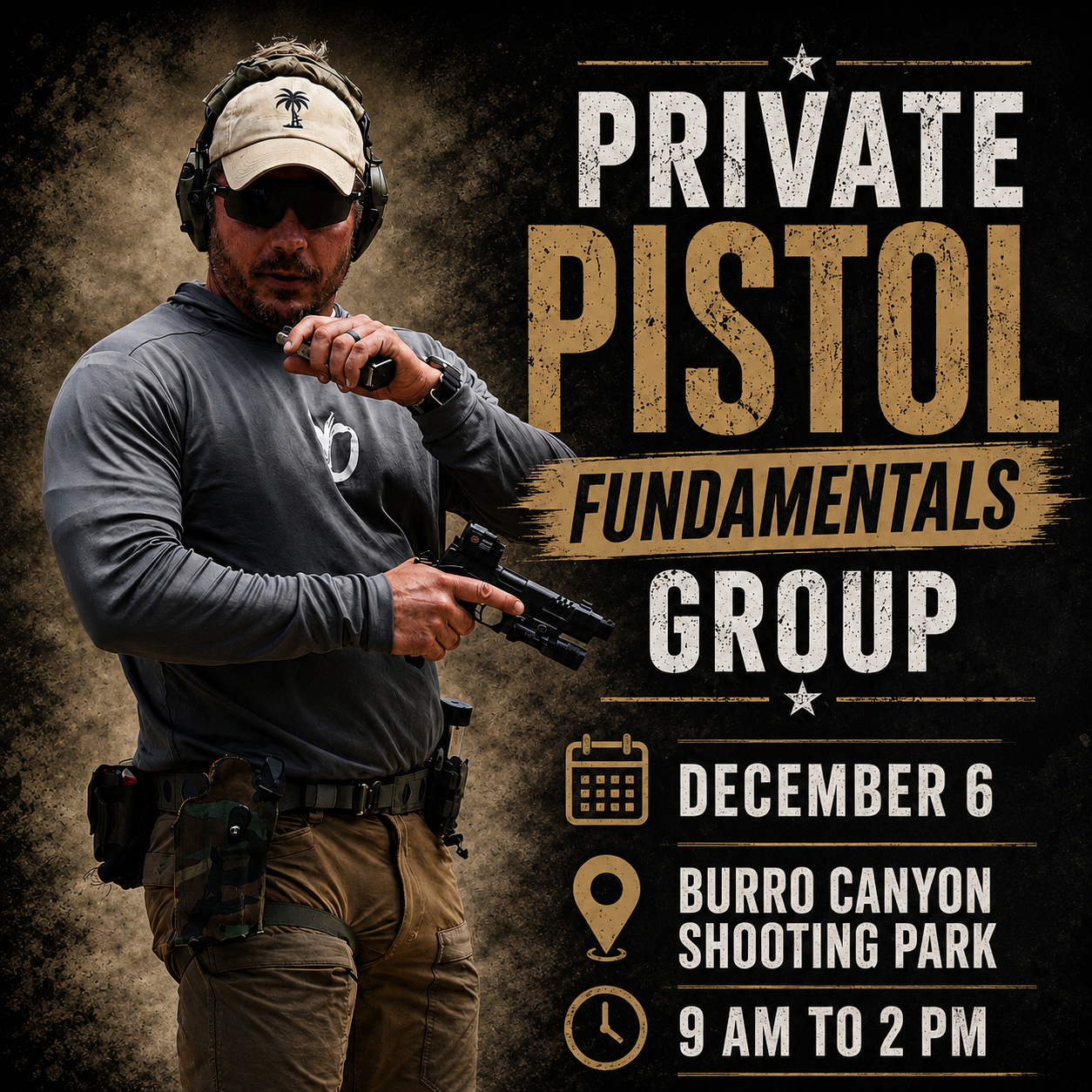
Private Pistol fundamentals group December 6th
PISTOL FUNDAMENTALS
December 6 | 9:00 AM–2:00 PM
Burro Canyon Shooting Park
7 Students
Round Count: 315 rounds per student
Total Class Ammunition: 2,205 rounds
Course Objective
Build a strong foundation in safe gun handling, grip, sights, trigger control, recoil management, presentation, reloads, and practical accuracy. The emphasis throughout the day is fundamentals performed correctly first, then applied with increasing speed.
⸻
9:00–9:30 — Safety / Fundamentals / Dry Work
Round Count: 0
Range safety and medical brief
Four universal firearm safety rules
Loading/unloading procedures
Range commands
Equipment and holster check
Proper stance and body position
Building a repeatable two-handed grip
Trigger-finger discipline
Sight alignment / sight picture
Trigger preparation and reset
Dry presentations from ready/holster as appropriate
⸻
9:30–9:50 — Accuracy Baseline
20 rounds
5–7 yards
5 rounds — deliberate slow fire
5 rounds — strong emphasis on grip
5 rounds — trigger-control focus
5 rounds — complete fundamentals
Goal: Establish each student’s starting point and identify grip, sighting, and trigger-control issues.
Running Total: 20
⸻
9:50–10:15 — Grip Development
30 rounds
5–7 yards
5 strings of 3 rounds — build grip and fire
3 strings of 5 rounds — maintain grip through recoil
Focus:
Support-hand pressure
Consistent hand placement
Wrist stability
Returning the sights naturally after recoil
Running Total: 50
⸻
10:15–10:40 — Trigger Control
30 rounds
5–10 yards
10 rounds — deliberate singles
10 rounds — controlled pairs
10 rounds — accuracy-focused strings
Emphasis on pressing the trigger without disturbing the sights and learning how quickly the trigger can be worked while maintaining accountability.
Running Total: 80
⸻
10:40–11:05 — Presentation
30 rounds
5–7 yards
10 × 1 round
5 × 2 rounds
2 × 5 rounds
Build the presentation progressively before adding speed.
Focus:
Consistent starting position
Efficient path to the target
Building the grip before firing
Finding the sights immediately
Trigger preparation during presentation
Running Total: 110
⸻
11:05–11:30 — Cadence & Recoil Management
30 rounds
5–10 yards
5 rounds — deliberate cadence
5 rounds — moderate cadence
5 rounds — faster cadence
Repeat sequence
Students learn that acceptable shooting speed is dictated by what the sights are doing and the difficulty of the target.
Running Total: 140
⸻
11:30–11:40 — BREAK / HYDRATION
⸻
11:40–12:05 — Controlled Pairs & Follow-Up Shots
30 rounds
7–10 yards
5 × 2-round strings
5 × 4-round strings
Focus on maintaining the same grip through multiple shots instead of rebuilding the gun between rounds.
Running Total: 170
⸻
12:05–12:30 — Reload Fundamentals
30 rounds
10 rounds — emergency/reload mechanics
10 rounds — reload followed by one accurate shot
10 rounds — reload followed by controlled pair
Dry repetitions should be performed between live-fire strings to maximize learning without unnecessarily increasing ammunition consumption.
Running Total: 200
⸻
12:30–12:55 — Multiple Target Fundamentals
30 rounds
5–10 yards
Three-target array.
2 rounds per target × 5 repetitions
Focus:
Eyes lead the gun
Drive the sights to the next target
Stop the gun where you intend to shoot
Confirm an acceptable sight picture
Maintain grip during transitions
Running Total: 230
⸻
12:55–1:20 — Distance & Accuracy
25 rounds
Progressively increase distance based on student ability.
5 rounds — 7 yards
5 rounds — 10 yards
5 rounds — 15 yards
5 rounds — 20 yards
5 rounds — 25 yards
This block reinforces that the fundamentals don’t change as distance increases—the acceptable margin for error does.
Running Total: 255
⸻
1:20–1:40 — Fundamental Standards
30 rounds
Combine the skills taught throughout the day:
Presentation
Accurate first shot
Follow-up shots
Recoil management
Reloads
Target transitions
Run short scored strings with an emphasis on accountability over raw speed.
Running Total: 285
⸻
1:40–1:55 — Final Performance Drill
30 rounds
Run a repeatable end-of-class standard combining:
Presentation
Controlled pairs
Multiple shots
Reload
Target transitions
Accuracy at varying distances
Students should be encouraged to push speed while maintaining the accuracy standard established by the instructor.
FINAL ROUND COUNT: 315 ROUNDS
⸻
1:55–2:00 — Debrief
Review individual strengths and deficiencies
Questions
Recommended dry-fire practice
Recommended live-fire practice
Equipment discussion as needed
Ammunition
315 rounds per student
7 students × 315 rounds = 2,205 total rounds
Recommended student requirement: Bring 350 rounds to provide a small reserve for make-ups, demonstrations, or ammunition-related issues.
Equipment
Reliable handgun
Quality holster
Minimum 3 magazines recommended
Magazine pouches
Eye protection
Ear protection
Appropriate range clothing/footwear
Water/electrolytes
Sunscreen
Notebook/pen
Training progression:
Safety → Accuracy → Grip → Trigger → Presentation → Recoil Management → Reloads → Transitions → Distance → Performance
Build the fundamentals. Apply them at speed. Hold yourself to a standard.
PISTOL FUNDAMENTALS
December 6 | 9:00 AM–2:00 PM
Burro Canyon Shooting Park
7 Students
Round Count: 315 rounds per student
Total Class Ammunition: 2,205 rounds
Course Objective
Build a strong foundation in safe gun handling, grip, sights, trigger control, recoil management, presentation, reloads, and practical accuracy. The emphasis throughout the day is fundamentals performed correctly first, then applied with increasing speed.
⸻
9:00–9:30 — Safety / Fundamentals / Dry Work
Round Count: 0
Range safety and medical brief
Four universal firearm safety rules
Loading/unloading procedures
Range commands
Equipment and holster check
Proper stance and body position
Building a repeatable two-handed grip
Trigger-finger discipline
Sight alignment / sight picture
Trigger preparation and reset
Dry presentations from ready/holster as appropriate
⸻
9:30–9:50 — Accuracy Baseline
20 rounds
5–7 yards
5 rounds — deliberate slow fire
5 rounds — strong emphasis on grip
5 rounds — trigger-control focus
5 rounds — complete fundamentals
Goal: Establish each student’s starting point and identify grip, sighting, and trigger-control issues.
Running Total: 20
⸻
9:50–10:15 — Grip Development
30 rounds
5–7 yards
5 strings of 3 rounds — build grip and fire
3 strings of 5 rounds — maintain grip through recoil
Focus:
Support-hand pressure
Consistent hand placement
Wrist stability
Returning the sights naturally after recoil
Running Total: 50
⸻
10:15–10:40 — Trigger Control
30 rounds
5–10 yards
10 rounds — deliberate singles
10 rounds — controlled pairs
10 rounds — accuracy-focused strings
Emphasis on pressing the trigger without disturbing the sights and learning how quickly the trigger can be worked while maintaining accountability.
Running Total: 80
⸻
10:40–11:05 — Presentation
30 rounds
5–7 yards
10 × 1 round
5 × 2 rounds
2 × 5 rounds
Build the presentation progressively before adding speed.
Focus:
Consistent starting position
Efficient path to the target
Building the grip before firing
Finding the sights immediately
Trigger preparation during presentation
Running Total: 110
⸻
11:05–11:30 — Cadence & Recoil Management
30 rounds
5–10 yards
5 rounds — deliberate cadence
5 rounds — moderate cadence
5 rounds — faster cadence
Repeat sequence
Students learn that acceptable shooting speed is dictated by what the sights are doing and the difficulty of the target.
Running Total: 140
⸻
11:30–11:40 — BREAK / HYDRATION
⸻
11:40–12:05 — Controlled Pairs & Follow-Up Shots
30 rounds
7–10 yards
5 × 2-round strings
5 × 4-round strings
Focus on maintaining the same grip through multiple shots instead of rebuilding the gun between rounds.
Running Total: 170
⸻
12:05–12:30 — Reload Fundamentals
30 rounds
10 rounds — emergency/reload mechanics
10 rounds — reload followed by one accurate shot
10 rounds — reload followed by controlled pair
Dry repetitions should be performed between live-fire strings to maximize learning without unnecessarily increasing ammunition consumption.
Running Total: 200
⸻
12:30–12:55 — Multiple Target Fundamentals
30 rounds
5–10 yards
Three-target array.
2 rounds per target × 5 repetitions
Focus:
Eyes lead the gun
Drive the sights to the next target
Stop the gun where you intend to shoot
Confirm an acceptable sight picture
Maintain grip during transitions
Running Total: 230
⸻
12:55–1:20 — Distance & Accuracy
25 rounds
Progressively increase distance based on student ability.
5 rounds — 7 yards
5 rounds — 10 yards
5 rounds — 15 yards
5 rounds — 20 yards
5 rounds — 25 yards
This block reinforces that the fundamentals don’t change as distance increases—the acceptable margin for error does.
Running Total: 255
⸻
1:20–1:40 — Fundamental Standards
30 rounds
Combine the skills taught throughout the day:
Presentation
Accurate first shot
Follow-up shots
Recoil management
Reloads
Target transitions
Run short scored strings with an emphasis on accountability over raw speed.
Running Total: 285
⸻
1:40–1:55 — Final Performance Drill
30 rounds
Run a repeatable end-of-class standard combining:
Presentation
Controlled pairs
Multiple shots
Reload
Target transitions
Accuracy at varying distances
Students should be encouraged to push speed while maintaining the accuracy standard established by the instructor.
FINAL ROUND COUNT: 315 ROUNDS
⸻
1:55–2:00 — Debrief
Review individual strengths and deficiencies
Questions
Recommended dry-fire practice
Recommended live-fire practice
Equipment discussion as needed
Ammunition
315 rounds per student
7 students × 315 rounds = 2,205 total rounds
Recommended student requirement: Bring 350 rounds to provide a small reserve for make-ups, demonstrations, or ammunition-related issues.
Equipment
Reliable handgun
Quality holster
Minimum 3 magazines recommended
Magazine pouches
Eye protection
Ear protection
Appropriate range clothing/footwear
Water/electrolytes
Sunscreen
Notebook/pen
Training progression:
Safety → Accuracy → Grip → Trigger → Presentation → Recoil Management → Reloads → Transitions → Distance → Performance
Build the fundamentals. Apply them at speed. Hold yourself to a standard.